Robinhood Text Scam Warning: Do Not Call This Number
NEWNow you can listen to Fox News articles!
Most scam text messages are easy to spot, but this one feels different. At first glance, the message appears polished and uses official branding that indicates credibility. It also includes serious-sounding technical details, which may make even cautious people like Bob pause rather than instantly delete it. He shared the text message with CyberGuy after doubting whether it could be real.
“I received a text message from someone, some entity I don’t recognize. Normally, I just delete this phishing spam, but in this case, I’m wondering if someone has my personal and financial information. Have you seen this before?”
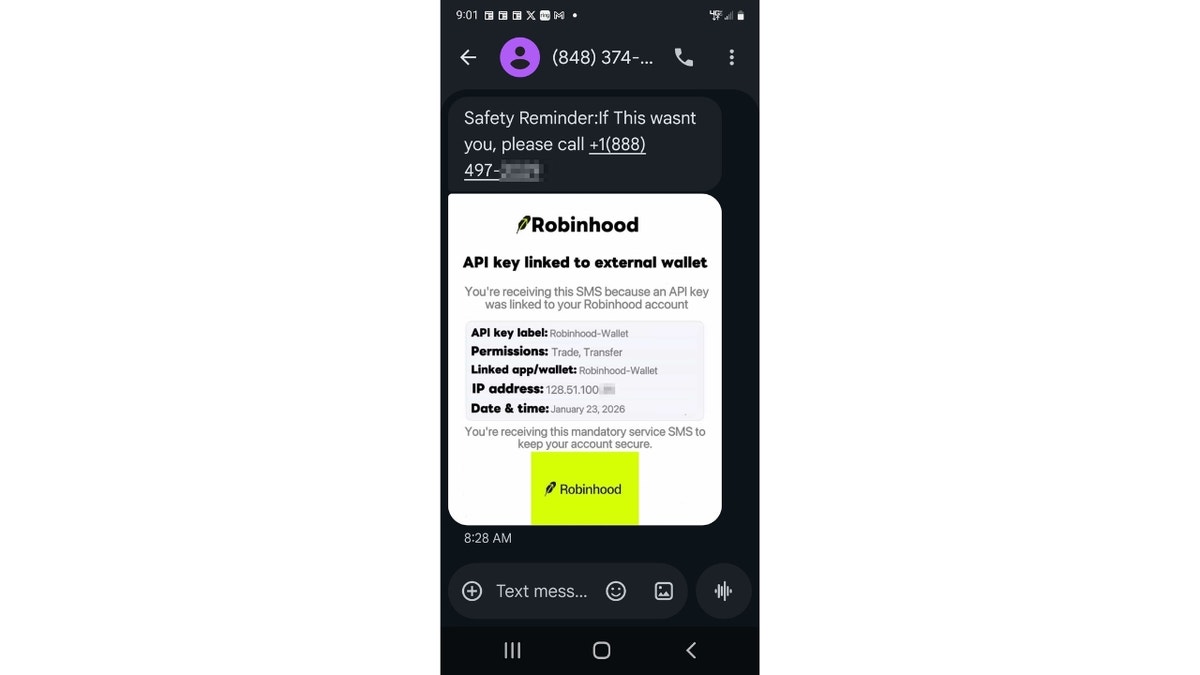
Yes, this exact message format has been circulating widely. The screenshot below points to a Robinhood phishing scam, not a legitimate security alert. For those of you who may not be familiar, Robinhood is a popular financial app that allows people to trade stocks, options, and cryptocurrencies from their phones.
Sign up to receive my FREE CyberGuy report
Get my best tech tips, urgent security alerts, and exclusive offers delivered straight to your inbox. Plus, you’ll get instant access to my Ultimate Guide to Surviving Scams, free when you join me CYBERGUY.COM information sheet.
MICROSOFT ‘IMPORTANT’ EMAIL IS A SCAM: HOW TO DETECT IT
Kurt “CyberGuy” Knutsson warns of a Robinhood phishing scheme. (Kurt “CyberGuy” Knutsson)
What the scam text really says
At the top of the message is a warning designed to create urgency:
“Safety reminder: If it wasn’t you, please call +1 (888) 497-####.”
Below that, a realistic-looking Robinhood chart states:
- An API key was linked to an external wallet
- Permits include trade and transfer.
- A linked wallet labeled Robinhood-Wallet
- An IP address listed as 128.51.100.##
- A date and time stamp for January 23, 2026.
The message ends up calling itself a mandatory service SMS meant to keep the account safe. To most people, this seems official. That feeling is intentional.
Why this message is designed to scare
This scam is based on presentation, not accuracy. Technical language like API key and IP address sounds authoritative. It creates pressure to act even when the details are unclear. The phone number is the real goal. Calling you connects you directly with scammers trained to appear calm, helpful and urgent at the same time. The message also purposely avoids links. A phone call seems safer than clicking, which reduces suspicion.
The most important thing to understand.
Receiving this text message does not mean that an account has been accessed. Messages like this are sent en masse. Phone numbers often come from unrelated people. data breaches and marketing lists. The sender does not know who actually has a Robinhood account. The scam only works if someone reacts.
A Robinhood spokesperson told us the company is seeing an increase in financial scams and says it has safeguards in place “to monitor, report and disrupt fraudulent activity.” The spokesperson urged customers not to get involved in suspicious scams and to use the resources on Robinhood’s support page to help identify and avoid them.
What to do right now if you receive this text message
If this message appears on your phone, pause for a moment. These scams are successful when fear takes over. Staying calm keeps you in control. These steps break the momentum of the scam and help protect your accounts before real damage can occur.
1) Do not call the phone number.
This is the most important step. The phone number in the text connects directly to scammers posing as Robinhood’s security team. Once on the call, they often state that there is an active threat and push for immediate action. They may ask you to verify account details, share unique codes, or approve fake transfers. No legitimate financial company takes care of account security through an unsolicited phone call.
2) Don’t click on links or reply to the message
Avoid interacting with the text at all. Reply confirms that your number is active, while clicking anything can lead to fake login pages, tracking scams, or malware. Powerful antivirus software can help block malicious links and scam sites if one is accessed accidentally, but the safest course of action is to ignore the message completely. Cutting off the interaction stops the scam immediately. The best way to protect yourself from malicious links that install malware and potentially access your private information is to have powerful antivirus software installed on all your devices. This protection can also alert you to phishing emails and ransomware scams, keeping your personal information and digital assets safe.
Get my picks for the best antivirus protection winners of 2026 for your Windows, Mac, Android, and iOS devices at Cyberguy.com
3) Verify your account securely
If you have a Robinhood account, always go directly to the source. Open the official app or manually type the website address into your browser. Never use links or phone numbers included in the text.
Once you’re logged in, review:
- Security alerts
- Recent account activity
- Linked Apps
- API or third party access
If nothing appears there, the message was fake and your account is safe.
TAX SEASON SCAMS ON THE RISE AS CONFUSION IN FILING GROWS
Cyber experts warn that a widely shared “Security Reminder” text is a Robinhood phishing scam, not an actual breach alert. (Photo Illustration by Scott Olson/Getty Images)
4) Activate two-factor authentication
Two-factor authentication (2FA) adds a critical layer of protection. Even if scammers obtain a password, they cannot access an account without the second verification step. This stops many account takeover attempts in their tracks.
5) Use strong and unique passwords
Never reuse passwords on financial accounts. Strong, unique passwords limit the damage caused by unrelated data breaches. A password manager can help generate and store strong passwords, so you don’t have to remember them.
Next, check to see if your email has been exposed in previous breaches. Our number one password manager (see Cyberguy.com) includes a built-in breach scanner that checks to see if your email address or passwords have appeared in known breaches. If you discover a match, immediately change any reused passwords and protect those accounts with new, unique credentials.
Check out the best expert-reviewed password managers of 2026 at Cyberguy.com.
6) Reduce exposure with a data removal service
If scam text messages like this keep appearing, it often means your phone number is circulating among data brokers. A data erasure service can help reduce that exposure over time.
While no service can guarantee complete removal of your data from the Internet, a data deletion service is truly a smart choice. They are not cheap, and neither is your privacy. These services do all the work for you by actively monitoring and systematically deleting your personal information from hundreds of websites. It’s what gives me peace of mind and has proven to be the most effective way to delete your personal data from the Internet. By limiting the information available, you reduce the risk of scammers cross-referencing leak data with information they can find on the dark web, making it harder for them to target you.
Check out my top picks for data removal services and get a free scan to find out if your personal information is already available on the web by visiting Cyberguy.com.
Get a free scan to find out if your personal information is already available on the web: Cyberguy.com.
7) Delete old or unused linked apps
Over time, accounts can accumulate connections that are no longer necessary. Review linked apps and remove anything you’re unfamiliar with or don’t use. Fewer connections mean fewer potential attack routes.
8) Block shipping number
After confirming that your account is secure, block the number who sent the message. This prevents repeated attempts from the same source and reduces future interruptions.
9) Report the message as spam
Robinhood encourages users to contact its customer support team if they have questions about scams or fraud or to verify suspicious messages. Suspected phishing attempts can be reported directly to report phishing@robinhood.comthe spokesperson said. Likewise, inform the message as spam in your messaging application. This helps improve filtering systems and can prevent similar scams from reaching other people.
10) Save the message as evidence.
Finally, before deleting it, take a screenshot. This gives you a record in case you need to report the scam later or explain what happened. It also helps eliminate doubts once the message disappears.
5 MYTHS ABOUT IDENTITY THEFT THAT PUT YOUR DATA AT RISK
Scammers use technical jargon and official-looking branding to trick users into revealing details of their financial accounts. (Photo Illustration by Cheng Xin/Getty Images)
Kurt’s Key Takeaways
This scam works by leveraging trust in a well-known brand and using fear to pressure you to make quick decisions. The message is designed to rush and intimidate, not to inform. The strongest defense is simple. Pause. Check accounts directly through official applications. Don’t let technical language or urgency force a reaction. You don’t need to understand all the details to stay safe. Questioning a message like this protects something much more valuable than time. And it raises an important question worth asking every time a security alert appears on your phone.
Have you recently received a suspicious security text message or call? Tell us how you thought it and how you handled it by writing to us at Cyberguy.com.
CLICK HERE TO DOWNLOAD THE FOX NEWS APP
Sign up to receive my FREE CyberGuy report
Get my best tech tips, urgent security alerts, and exclusive offers delivered straight to your inbox. Plus, you’ll get instant access to my Ultimate Guide to Surviving Scams, free when you join me CYBERGUY.COM information sheet.
Copyright 2026 CyberGuy.com. All rights reserved.
Reference: Read Latest News in Spanish